JointBrex Ingredients: All Eight Label Lines, Line by Line
Quick answer
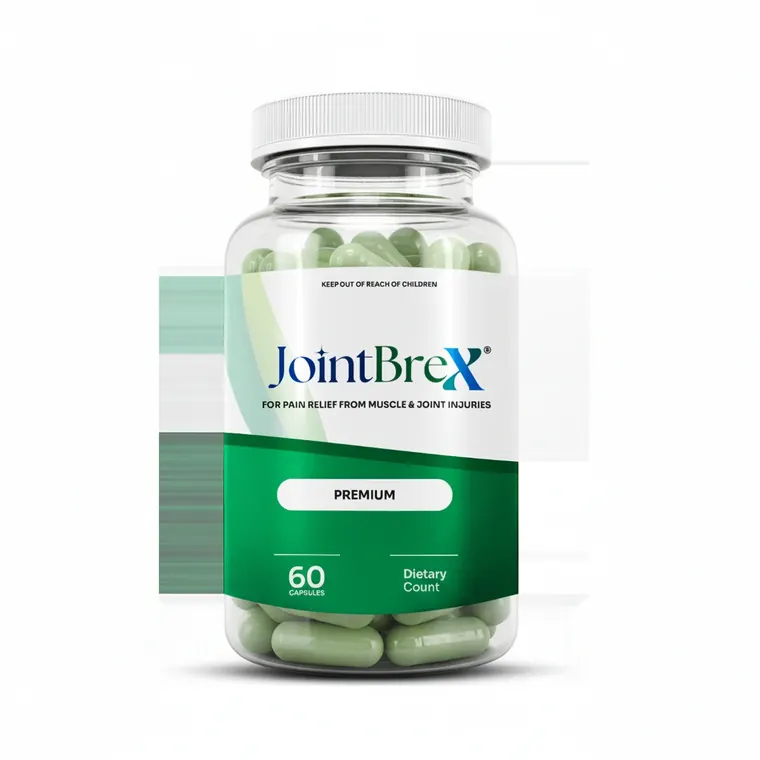
JointBrex has eight ingredients in each 2-capsule serving, led by glucosamine sulfate.
The label lists glucosamine sulfate 1,000 mg (from crayfish), boswellia extract 133.3 mg, chondroitin sulfate 100 mg and turmeric root 100 mg, plus quercetin, methionine, MSM and bromelain at 16.7 mg each.
Want the panel as printed? Read the supplement facts.
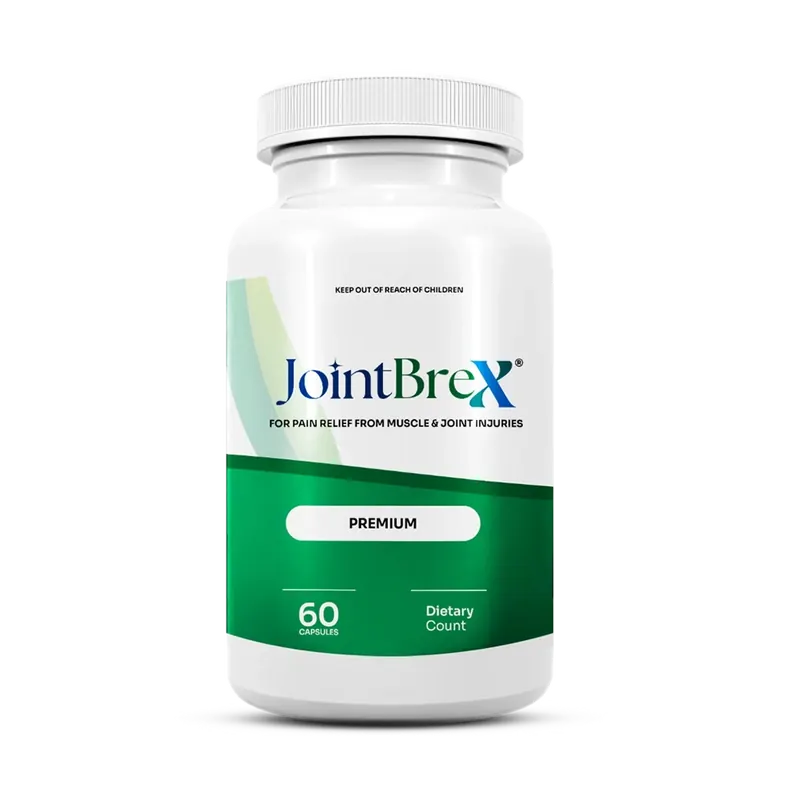
What is in JointBrex? The full ingredients list from the bottle
The JointBrex Supplement Facts panel names eight ingredients in a serving of 2 vegetable capsules, 1,400.1 mg in total. One of them, glucosamine sulfate, makes up almost three-quarters of that weight.
| Label line | Per 2 capsules | Share of 1,400.1 mg | Source the label names | Details |
|---|---|---|---|---|
| Glucosamine Sulfate | 1,000 mg | 71.4% | Crustacean shellfish (crayfish), from the allergen line | Glucosamine page |
| Boswellia Extract (Boswellia serrata) (resin) | 133.3 mg | 9.5% | Tree resin; extract strength not on the label | Boswellia page |
| Chondroitin Sulfate | 100 mg | 7.1% | not on the label | Chondroitin page |
| Turmeric (Curcuma longa) (root) | 100 mg | 7.1% | Root; curcumin content not on the label | Turmeric page |
| Quercetin (Sophora japonica) (bud) | 16.7 mg | 1.2% | Flower bud | Below |
| Methionine | 16.7 mg | 1.2% | not on the label | Below |
| MSM (Methylsulfonylmethane) | 16.7 mg | 1.2% | not on the label | MSM page |
| Bromelain (Ananas comosus) (stem) | 16.7 mg | 1.2% | Pineapple stem | Bromelain page |
Below the panel the label adds two other ingredients, cellulose (the capsule) and rice flour, and one allergen line: "Contains: Crustacean shellfish (crayfish)."
Why do the JointBrex ingredient lists on the label, sales page and seller pack disagree?
They were made separately, and only the bottle label is complete. The sales page names six ingredients with no amounts, the seller pack names a different six, and the brand graphic below matches the pack.
| Ingredient | Bottle label | Sales page | Seller pack | Brand graphic |
|---|---|---|---|---|
| Glucosamine sulfate | 1,000 mg | Yes | Yes | Yes |
| Boswellia extract | 133.3 mg | Yes | Yes | Yes |
| Chondroitin sulfate | 100 mg | Yes | Yes | Yes |
| Turmeric root | 100 mg | Yes | Yes | Yes |
| Quercetin | 16.7 mg | No | Yes | Yes |
| Methionine | 16.7 mg | No | Yes | Yes |
| MSM | 16.7 mg | Yes | No | No |
| Bromelain | 16.7 mg | Yes | No | No |
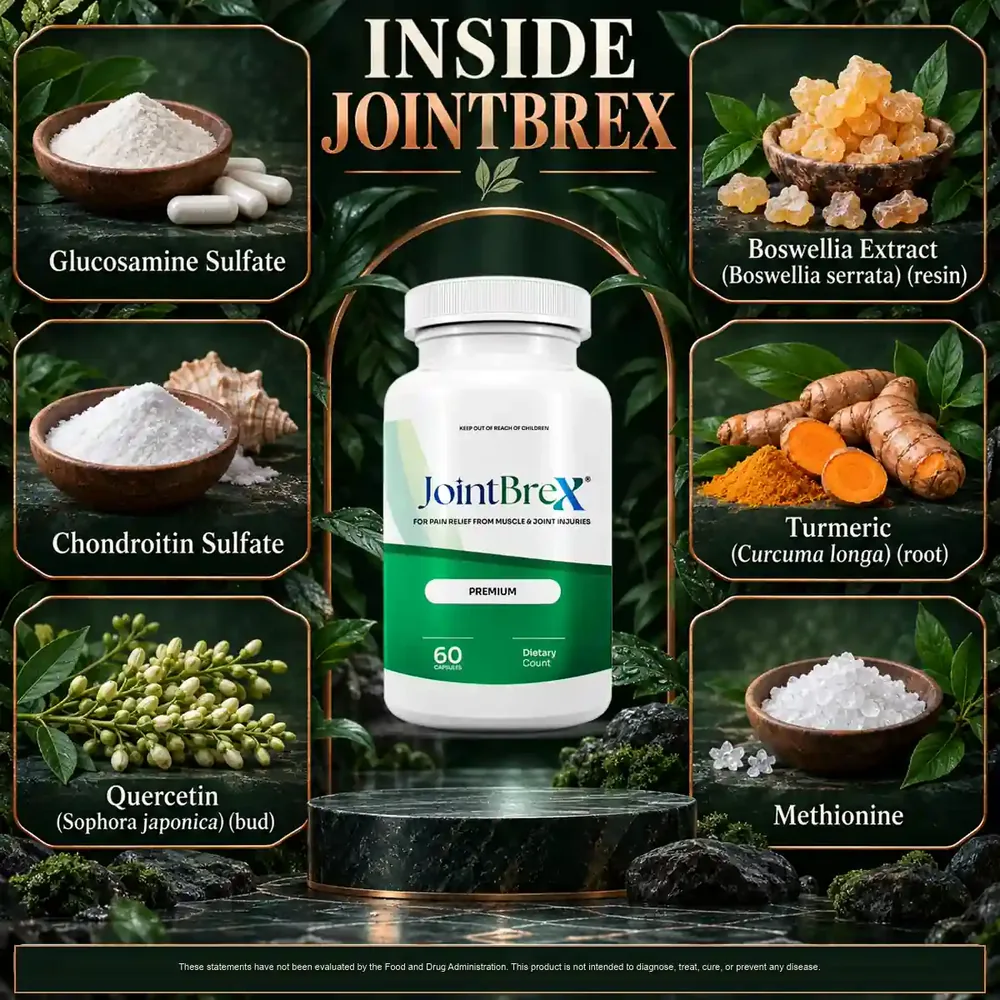
- Glucosamine sulfate. Drawn as white powder. The real source is crayfish, which the picture does not show.
- A seashell by the chondroitin. Props only. The label never says what animal the chondroitin comes from.
- Quercetin buds. On the label and in this graphic, yet left off the sales page list.
- Methionine. The second ingredient the sales page skips.
- The bottle front. "For pain relief from muscle & joint injuries" is drug-style wording on a dietary supplement.
- Two tiles missing. No MSM and no bromelain appear here, though both are on the panel at 16.7 mg.
Some affiliate pages describe yet another "JointBrex" with turmeric extract, forskolin and BioPerine. That is not this bottle. When lists clash, trust the printed panel.
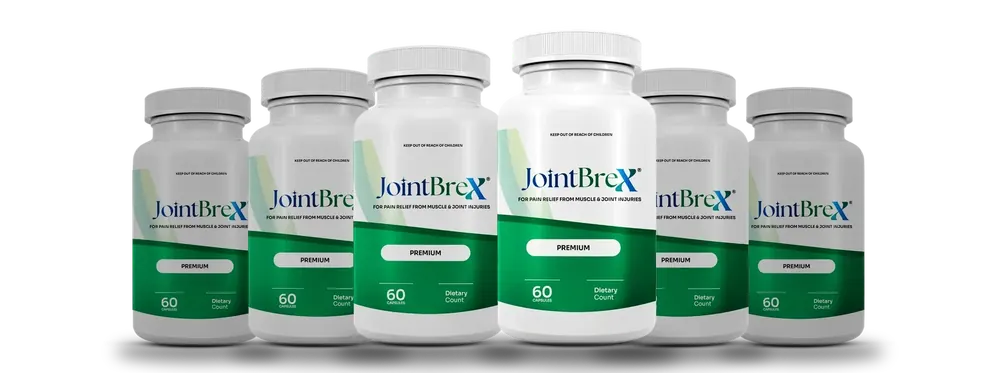
Weighing up JointBrex? The lowest cost per bottle comes with the 6-bottle pack.
$49 a bottle in the 6-pack ($294). Free US delivery on 3 or 6 · 60-day refund window · BuyGoods checkout.
Are the JointBrex amounts big enough to match the research?
Mostly not. Boswellia is the one amount inside a range that trials used; glucosamine reaches two-thirds of the usual figure, chondroitin about 8%, and MSM and bromelain only a few percent.
Label: 1,000 mg. Studied: 1,500 mg daily, the GAIT trial and most package directions. (NEJM 2006, Clegg et al., GAIT trial) (Cochrane 2005, Towheed et al., Glucosamine for osteoarthritis) (LiverTox (NIDDK), Glucosamine)
Label: 100 mg. Studied: 1,200 mg daily in GAIT; LiverTox lists 600 to 1,200 mg. (NEJM 2006, Clegg et al., GAIT trial) (LiverTox (NIDDK), Glucosamine)
Label: 133.3 mg. Studied: 100 to 250 mg daily of branded, AKBA-enriched extracts. (Cochrane 2014, Cameron and Chrubasik, Oral herbal therapies for OA) (BMC Complement Med Ther 2020, Yu et al., Boswellia meta-analysis)
Label: 100 mg. Studied: 93 mg to 2 g daily of absorption-boosted curcumin. (BMJ Open Sport Exerc Med 2021, Paultre et al., Turmeric/curcumin for knee OA) (Complement Ther Med 2021, High- vs low-dose curcumin in knee OA)
Label: 16.7 mg. Studied: 1,000 to 3,000 mg daily in common use. (Arthritis Foundation, Supplement and Herb Guide for Arthritis Symptoms)
Label: 16.7 mg. Studied: 500 to 2,000 mg per dose, up to three doses a day. (Arthritis Foundation, Supplement and Herb Guide for Arthritis Symptoms)
Each bar treats one 2-capsule serving as the whole day, as the label directs, and the label says not to exceed it. Quercetin and methionine have no bar: no studied joint dose exists for either.
What does each JointBrex ingredient cost per day?
At the 6-bottle price, a day of JointBrex costs about $1.63 and delivers 1,400.1 mg, so you pay about $1.17 per gram of listed ingredients (our arithmetic from pack prices).
| Pack | Per capsule | Per day (2 capsules) | Per gram of ingredients | Per 100 mg |
|---|---|---|---|---|
| 1 bottle, $89 plus shipping | $1.48 | $2.97 | $2.12 | 21¢ |
| 3 bottles, $177 | $0.98 | $1.97 | $1.40 | 14¢ |
| 6 bottles, $294 | $0.82 | $1.63 | $1.17 | 12¢ |
Split by weight, a $1.63 day is about $1.17 of glucosamine, 16¢ of boswellia, 12¢ each of chondroitin and turmeric, and 8¢ for the four small extras. Price per gram says nothing about quality.
Quercetin in JointBrex: what it is and who should check first
Quercetin is a flavonoid, one of the colored compounds plants make. JointBrex lists 16.7 mg, and the panel names the source as the bud of Sophora japonica, a flowering tree.
People search for quercetin for joint pain, but we found no joint trial and no studied dose to compare. Memorial Sloan Kettering says it has not been shown to treat any disease, and its anti-inflammatory effects come from lab work only (Memorial Sloan Kettering, Quercetin (About Herbs)).
Medicine cautions from the same source
- In lab tests it blocked two liver enzymes, CYP3A4 and CYP2C19. MSK lists drugs cleared by those enzymes, and the blood pressure drug losartan, as reasons not to take quercetin.
- One case report describes a man on a steady warfarin dose whose INR rose after he began quercetin and settled once he stopped.
The amount is modest, but nobody has tested it beside your prescriptions. Show your pharmacist the whole label.
Methionine in JointBrex: an amino acid with no joint evidence
Methionine is one of the amino acids your body uses to build protein, and ordinary protein foods supply it every day. JointBrex adds 16.7 mg per serving without saying why, and the sales page leaves it out of its own list.
We found no evidence on methionine and joints and no studied dose. The free MedlinePlus supplement monographs went offline on July 29, 2025 (MedlinePlus, Herbs and Supplements (index; monographs retired)), and we do not stretch research on related compounds to cover this one.
It is also the only one of the eight with no blood thinner warning in our sources. Treat it as a minor extra.
Is JointBrex shellfish free? Where each ingredient comes from
No. The label states "Contains: Crustacean shellfish (crayfish)", and that applies to the glucosamine. Four label ingredients come from plants: boswellia resin, turmeric root, Sophora japonica buds and pineapple stem.
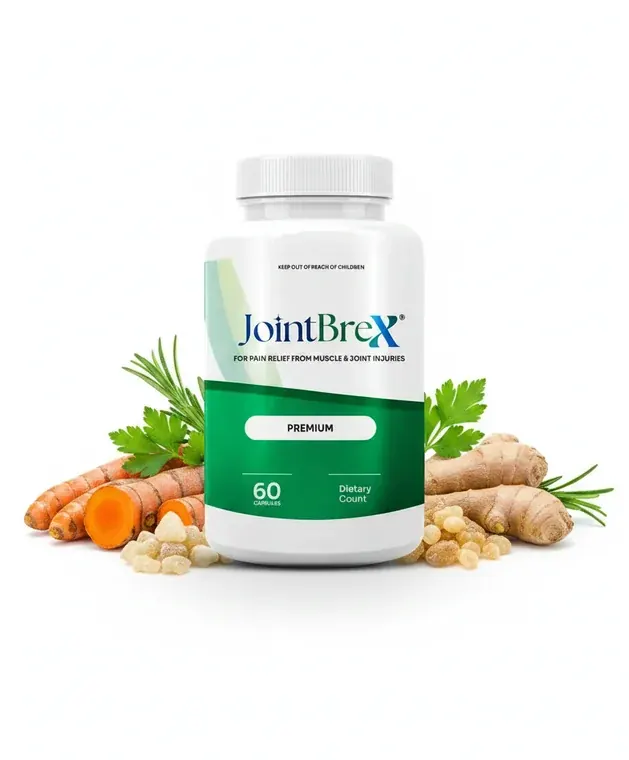
Chondroitin is the gap: its source is not printed, and chondroitin usually comes from animal cartilage.
Cellulose and rice flour: is rice flour in supplements good or bad?
Neither, for most people. Rice flour is a filler and flow agent: it tops up each capsule to a steady fill weight and helps fine powders run smoothly through capsule machines. Rice is naturally gluten free.
- Cellulose (vegetable capsule)
- The shell. Plant cellulose, not gelatin, which is made from animal parts.
- Rice flour
- Filler inside the shell. Amount not printed. Gluten free by nature.
- What "vegetable capsule" covers
- Only the shell. The powder inside includes crayfish glucosamine.
A brand seal calls the product "Naturally Gluten Free". Rice flour fits that, but no test result is published, so anyone with celiac disease should treat the seal as a claim.
JointBrex ingredients: your questions answered
What is the JointBrex ingredients list?
Each 2-capsule serving lists glucosamine sulfate 1,000 mg, boswellia extract 133.3 mg, chondroitin sulfate 100 mg, turmeric root 100 mg, and quercetin, methionine, MSM and bromelain at 16.7 mg each. Other ingredients are cellulose and rice flour.
Why does the sales page list only six ingredients?
It omits quercetin and methionine and gives no amounts. The bottle label lists all eight with amounts, so use the label.
Is JointBrex vegetarian or vegan?
No. The capsule shell is vegetable cellulose, but the glucosamine is made from crayfish and the chondroitin source is not stated.
Is rice flour in supplements bad for you?
Not for most people. It is a gluten-free filler that helps capsules fill evenly; the label does not say how much is used.
Is quercetin good for joint pain?
We found no joint trial showing that. Memorial Sloan Kettering says its anti-inflammatory effects are from lab studies only.
What does methionine do in the body?
It is an amino acid used to build protein, supplied by everyday protein foods. We found no evidence that it helps joints.
How much does a day of JointBrex cost?
About $1.63 on the 6-bottle pack, $1.97 on 3 bottles and $2.97 on one bottle plus shipping, at 2 capsules a day.
Why is there crayfish in JointBrex?
Glucosamine is usually made from shellfish shells, and the label names crayfish as its source. The chondroitin source is not stated.
Page check
Written by
Matches each amount to the printed Supplement Facts panel and each safety line to federal health agencies and Cochrane reviews.
- Reviewed against the label on October 13, 2026
- Sources: the Supplement Facts panel, the brand pages we opened, and the studies linked on this page
- Spotted a mistake? Email [email protected]. Our method is on the editorial standards page