USA authorized retailer60-day refund windowUS delivery is free with 3 or 6 bottles$49 a bottle in the 6-pack ($294)

Reading a Joint Supplement Label: A Spot-by-Spot Walk Through the JointBrex Panel

Quick answer

Start with serving size: on JointBrex it is 2 capsules, and every amount is for both. Daggers mean no Daily Value exists. Brackets name the plant part, such as turmeric root. Then read other ingredients, the Contains line (crayfish here) and who is named: only a distributor. The asterisk on “pain relief” points to the FDA disclaimer.

Written by the JointBrex Editorial DeskUpdated

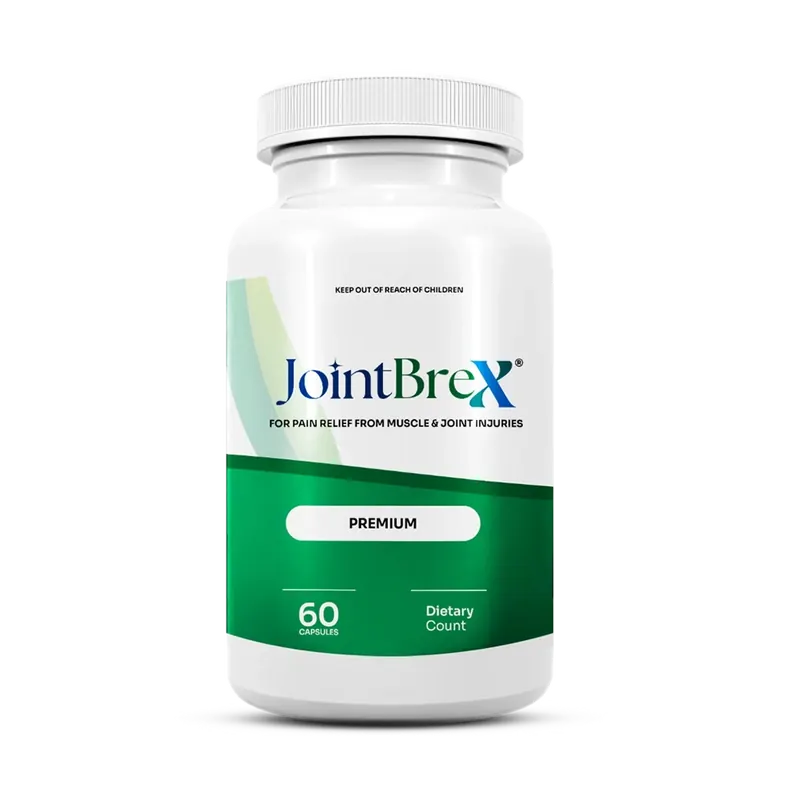
One JointBrex bottle with a green and white label reading For pain relief from muscle and joint injuries

A joint supplement label is short, and nearly every word on it does a job. Once you know the jobs, you can size up any bottle in a few minutes: how much you get, from what, made by whom, and which claims the label itself admits are untested.

The JointBrex label is our worked example. The same checks work on any brand.

What does the JointBrex label say, spot by spot?

Tap a number on the flat label to read its note. The legend below repeats every note.

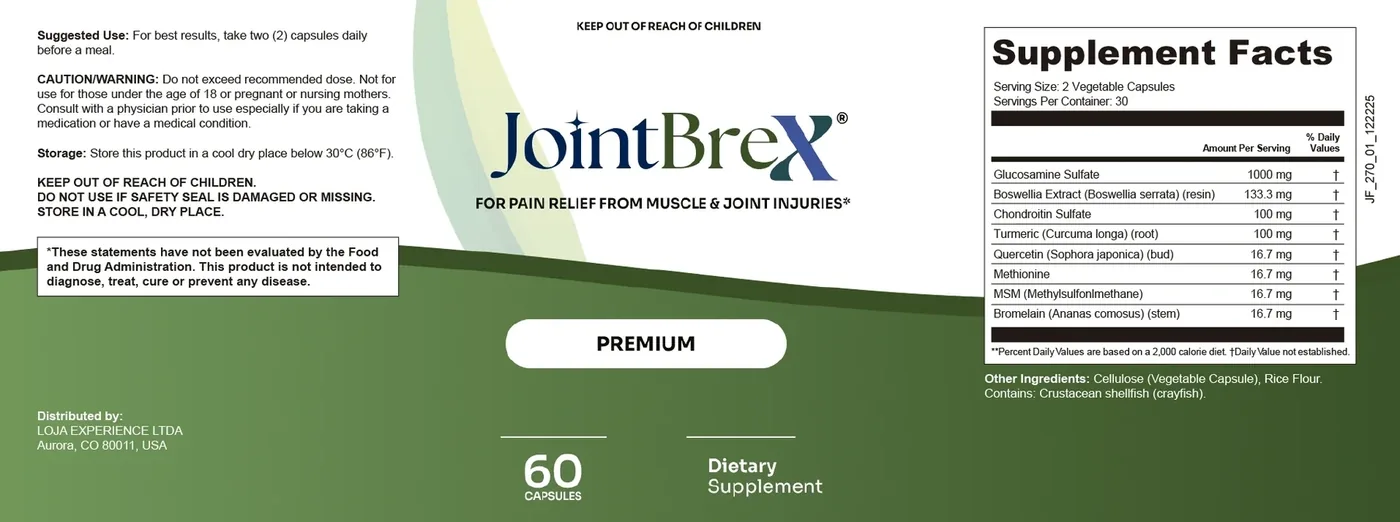
The full flat JointBrex bottle label: directions and warnings on the left, the brand name and front claim in the middle, the Supplement Facts panel and other ingredients on the right
  1. Suggested use. Two capsules daily before a meal.
  2. Caution block. Do not exceed the dose; not for under 18, pregnancy or nursing; ask a physician first if you take a medicine or have a condition.
  3. The FDA box. The FDA has not evaluated these claims. The front asterisk points here.
  4. Distributed by. LOJA EXPERIENCE LTDA, Aurora, CO 80011. A distributor, not a named maker, and no street address.
  5. Front claim. “For pain relief from muscle & joint injuries*”. Drug-style wording, covered below.
  6. PREMIUM. A marketing word. It has no defined meaning on a supplement label.
  7. Serving size. 2 vegetable capsules, 30 servings per container, so one bottle lasts 30 days.
  8. Plant part in brackets. Boswellia (resin), turmeric (root), quercetin (bud), bromelain (stem): the part of the plant used.
  9. Dagger column. Every row ends in a dagger: Daily Value not established.
  10. Other ingredients and Contains line. Cellulose (vegetable capsule), rice flour. Contains: crustacean shellfish (crayfish).

The side code JF_270_01_122225 is a label print code, not a test result. Our full transcription is on the JointBrex Supplement Facts page.

JointBrex bottles

Weighing up JointBrex? The lowest cost per bottle comes with the 6-bottle pack.

$49 a bottle in the 6-pack ($294). Free US delivery on 3 or 6 · 60-day refund window · BuyGoods checkout.

Check today’s price

How do you read serving size on a joint supplement?

Read it first, because every amount is per serving. Here a serving is 2 capsules, so each capsule holds half of each line.

The JointBrex amounts at three scales, worked out from the label
Label linePer serving (2 capsules)Per capsulePer bottle (30 servings)
Glucosamine sulfate1,000 mg500 mg30,000 mg (30 g)
Boswellia extract (resin)133.3 mgabout 66.7 mgabout 4,000 mg
Chondroitin sulfate100 mg50 mg3,000 mg
Turmeric (root)100 mg50 mg3,000 mg
Quercetin, methionine, MSM, bromelain16.7 mg eachabout 8.4 mg eachabout 500 mg each
All eight together1,400.1 mgabout 700 mgabout 42,000 mg

Check that a serving equals a day. Here the directions say two capsules daily, so they match.

Never add capsules to reach a dose you read about in a study. The caution block says not to exceed the recommended dose, and our post on 1,000 mg of glucosamine explains how the label compares with trial amounts.

What does a dagger in the % Daily Value column mean?

It means no official daily target exists for that ingredient. The footnote on the panel spells it out: “Daily Value not established.” All eight rows on this label carry the mark.

That is normal for glucosamine and plant extracts. It does not mean zero, safe or useless; it means the label cannot tell you whether 1,000 mg is a lot. For that you need study doses, shown on our ingredient pages.

Why does a supplement label put plant parts in brackets?

Because the part matters: a root, a resin and a stem hold different compounds. Turn each card for the research.

Supplement Facts panel line for boswellia extract, resin, 133.3 mg

Tree resin extract

Boswellia (resin)

Boswellia serrata

The word “extract” is there, but no percentage of any active compound is printed.

Boswellia (resin): the research

Studied at
100 mg a day of enriched extracts in the best data; 100 to 250 mg in later trials
What studies found
About 17 points less pain on a 100-point scale at 90 days, from small studies
Watch for
May raise bleeding risk with blood thinners (MSK)
In JointBrex
133.3 mg, inside the studied range, extract type not named
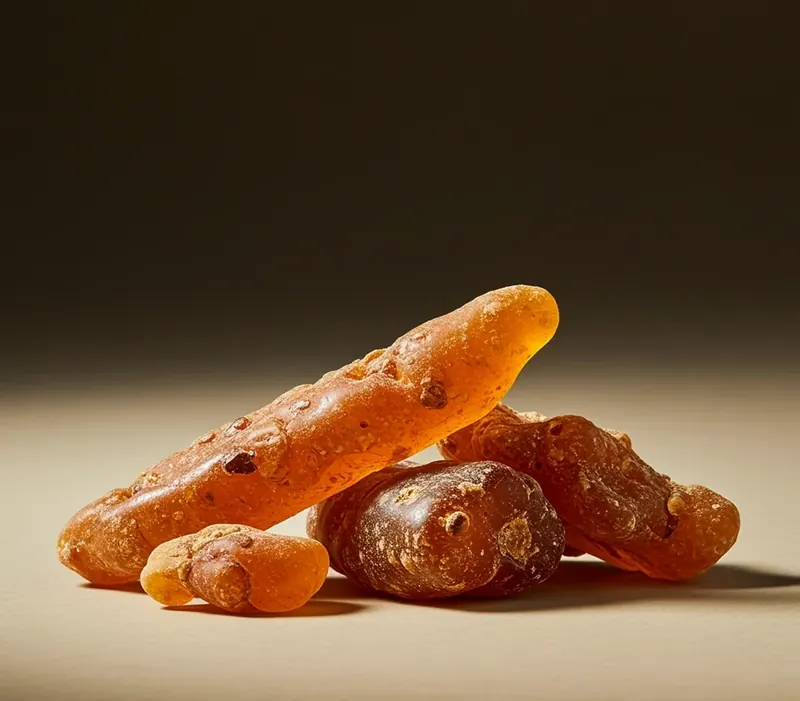
Pieces of dried turmeric root on a dark surface

Ground root

Turmeric (root)

Curcuma longa

Root, not curcumin extract. The label does not say how much curcumin the root holds.

Turmeric (root): the research

Studied at
93 mg to 2 g a day of enhanced curcumin products
What studies found
An apparent benefit for knee OA pain in trials of those enhanced products
Watch for
Turmeric products are a known cause of liver injury (LiverTox)
In JointBrex
100 mg of root powder
Supplement Facts panel line for quercetin, Sophora japonica bud, 16.7 mg

Plant flavonoid

Quercetin (bud)

Sophora japonica

The label names the flower bud of Sophora japonica as the source.

Quercetin (bud): the research

Studied at
No joint trial or study dose found
What studies found
Effects come from lab studies only (MSK)
Watch for
Listed as a reason for caution with certain medicines and one raised-INR case on warfarin
In JointBrex
16.7 mg
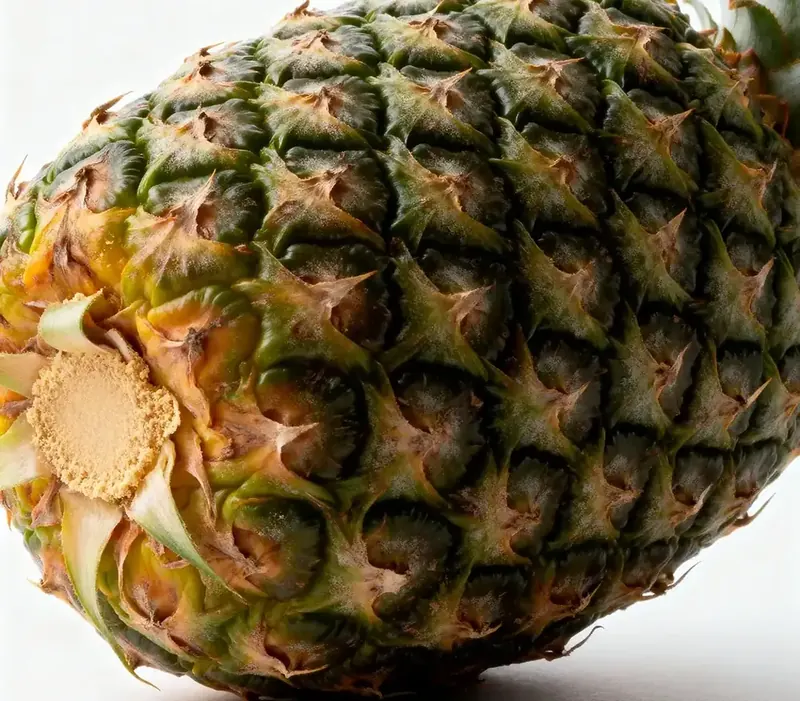
A whole pineapple, the plant bromelain comes from

Pineapple enzyme

Bromelain (stem)

Ananas comosus

An enzyme from the pineapple plant’s stem.

Bromelain (stem): the research

Studied at
500 to 2,000 mg, three times a day (Arthritis Foundation)
What studies found
Arthritis data are mixed; its own effects are unclear (NCCIH)
Watch for
Avoid with a pineapple allergy
In JointBrex
16.7 mg, about 3% of one low dose

Sources for the cards: (Cochrane 2014, Cameron and Chrubasik, Oral herbal therapies for OA) (BMJ Open Sport Exerc Med 2021, Paultre et al., Turmeric/curcumin for knee OA) (Memorial Sloan Kettering, Quercetin (About Herbs)) (Arthritis Foundation, Supplement and Herb Guide for Arthritis Symptoms)

What do the other ingredients and the Contains line tell you?

They tell you what else is in the capsule and what could cause an allergic reaction. On this label: cellulose (the vegetable capsule shell) and rice flour, then “Contains: crustacean shellfish (crayfish).”

Rice flour

Is rice flour in supplements good or bad? The label does not say what job it does, and our sources raise no concern about it.

A vegetable capsule is not a vegetarian product

The shell is plant cellulose, but the glucosamine inside comes from crayfish, and the label does not say where the chondroitin comes from. The Arthritis Foundation notes chondroitin is usually made from cow, pig or shellfish cartilage (Arthritis Foundation, Supplement and Herb Guide for Arthritis Symptoms).

The allergen line

Read it before anything else if you have a food allergy. Glucosamine is usually made from shellfish shells (LiverTox (NIDDK), Glucosamine), so anyone allergic to shellfish should not take this capsule without an allergist’s advice.

Who made it? Reading the distributor line

The JointBrex label says “Distributed by LOJA EXPERIENCE LTDA, Aurora, CO 80011, USA.” It names no maker and gives no street address. A distributor sells the product; it may or may not make it.

The sales page says the capsules are made in a US FDA-registered facility but does not name it, and no batch lab report is published. When the maker is missing, ask the seller in writing. Our testing and quality page goes through the seals and what each one proves.

What does the asterisk after a front-label claim mean?

It sends you to the FDA box: the claim has not been evaluated by the FDA, and the product is not meant to diagnose, treat, cure or prevent any disease. Supplement labels may describe effects on normal body structure or function this way, but not disease claims (FDA, Structure/Function Claims).

The JointBrex front panel stretches that line. A product meant to treat or ease the symptoms of a disease is regulated as a drug (FDA, FDA 101: Dietary Supplements), and “pain relief from injuries” reads like drug wording. Here is how each front-panel phrase holds up.

  • For pain relief from muscle & joint injuries*Bottle front
    Marketing only

    Drug-style wording. No study of this formula exists, and it is not a pain reliever.

  • Dietary SupplementBottle front
    On the label

    The legal category. It means the FDA did not approve the product before sale.

  • PREMIUMBottle front
    Marketing only

    No defined meaning. It is not a grade, test or certification.

  • 60 capsulesBottle front
    On the label

    Matches the panel: 30 servings of 2 capsules.

  • Name of the makerNowhere on the label
    Not shown

    Only a distributor is named.

Want the full story on registration, GMP seals and the FDA? Read FDA registered vs FDA approved.

Which warnings should you read twice?

The line telling you to consult a physician if you take a medication. The label stops there, but glucosamine has raised INR in people on warfarin (Health Sciences Authority, Warfarin-glucosamine interaction reports), and seven of the eight ingredients carry a bleeding caution. If you take a blood thinner, bring the label to your pharmacist.

Questions about reading a joint supplement label

What is the full JointBrex ingredients list?

Each 2-capsule serving lists glucosamine sulfate 1,000 mg, boswellia extract 133.3 mg, chondroitin sulfate 100 mg, turmeric root 100 mg, and quercetin, methionine, MSM and bromelain at 16.7 mg each.

What does “Daily Value not established” mean on a label?

There is no official daily target for that ingredient, so the label cannot show a percentage. It says nothing about safety or strength.

Is rice flour in supplements good or bad?

Our sources raise no concern about it. The label lists it as an other ingredient without saying what job it does.

Does a vegetable capsule make JointBrex vegan?

No. The shell is plant cellulose, but the glucosamine comes from crayfish and the chondroitin source is not stated.

What does PREMIUM mean on the Joint Brex bottle?

Nothing defined. It is a marketing word, and it is the only variant name on our label.

Who makes JointBrex?

The label does not say. It names a distributor, LOJA EXPERIENCE LTDA in Aurora, Colorado, and the sales page names no factory.

Why does a supplement label say pain relief?

Not as a treatment claim. On JointBrex the line carries an asterisk to the FDA disclaimer; treat it as marketing.

Page check

Written by

JointBrex Editorial Desk

Matches each amount to the printed Supplement Facts panel and each safety line to federal health agencies and Cochrane reviews.

Medical review

Dr. Teo Mendez, MD, Physician

Medical reviewer. Review date: October 13, 2026.

  • Reviewed against the label on October 13, 2026
  • Sources: the Supplement Facts panel, the brand pages we opened, and the studies linked on this page
  • Spotted a mistake? Email [email protected]. Our method is on the editorial standards page