Glucosamine Sulfate in JointBrex: Is 1,000 mg Enough, and Is It Safe for You?
Quick answer
JointBrex gives 1,000 mg of glucosamine sulfate a day, made from crayfish. Most studies used 1,500 mg, and even that was no better than placebo overall in the GAIT trial. Take it before a meal as the label says. Skip it with a shellfish allergy, and ask your prescriber first if you take Eliquis, warfarin or diabetes medicine.
Is 1,000 mg of glucosamine enough?
By the numbers most research used, no: JointBrex gives 1,000 mg a day, while the usual studied amount is 1,500 mg. But the bigger catch is that 1,500 mg itself did not clearly beat a dummy pill in the largest US trial, so a larger dose is no promise of a better result either.
| Where the figure comes from | Glucosamine per day | JointBrex 1,000 mg as a share |
|---|---|---|
| JointBrex label, 2 capsules | 1,000 mg (sulfate) | 100% |
| GAIT trial, 24 weeks (NEJM 2006, Clegg et al., GAIT trial) | 1,500 mg | 67% |
| Typical package directions (Cochrane 2005, Towheed et al., Glucosamine for osteoarthritis) | 1,500 mg (500 mg three times a day) | 67% |
| LiverTox usual dose (LiverTox (NIDDK), Glucosamine) | 500 mg three times daily | 67% |
| Arthritis Foundation guide (Arthritis Foundation, Supplement and Herb Guide for Arthritis Symptoms) | 500 mg to 3 g, for combined glucosamine and chondroitin products | Not comparable |
So 1,000 mg is not too much by these sources; it sits a third below the common figure. It is also not a dose any trial we found tested on its own. Our longer post on the 1,000 mg question walks through where the 1,500 mg habit started.
What the JointBrex label says about its glucosamine
Six lines on the printed label bear on the glucosamine: the amount, the serving, the source, the timing and two warnings. Tap each number on the panel below.
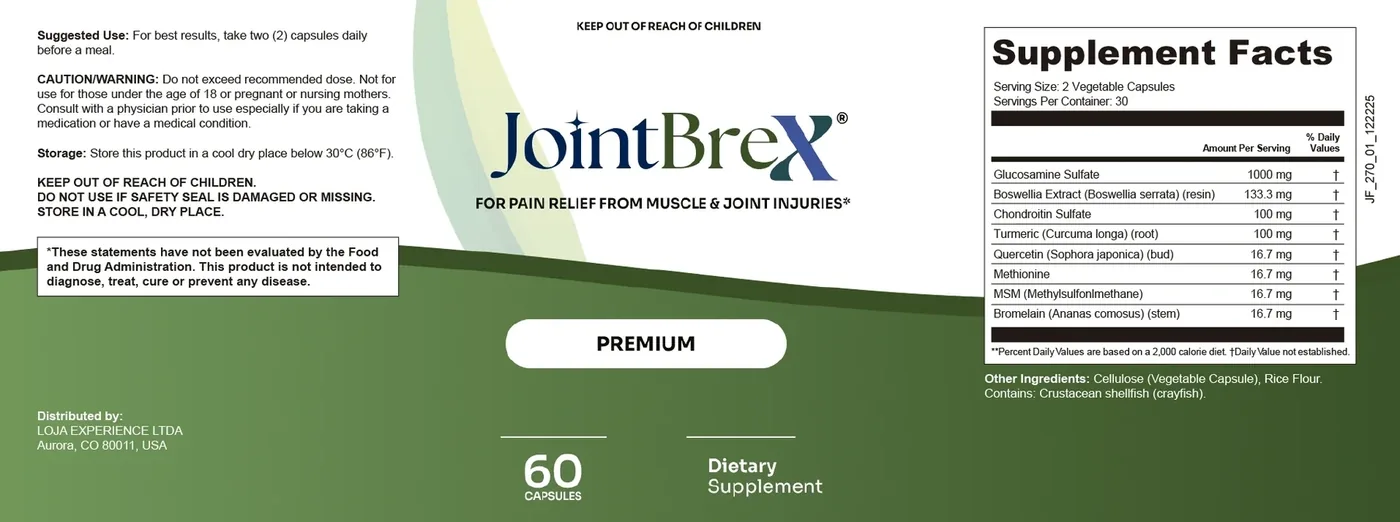
- Glucosamine Sulfate 1000 mg. The top line and the largest amount, about 71% of the 1,400.1 mg serving.
- Serving size: 2 vegetable capsules. The 1,000 mg is for both capsules together, 500 mg in each.
- Contains: Crustacean shellfish (crayfish). The glucosamine is the shellfish part of the formula.
- Take two capsules daily before a meal. The only timing advice the brand gives.
- Consult a physician first. Especially if you take a medication or have a medical condition.
- "For pain relief from muscle & joint injuries". Drug-style wording. Glucosamine is not a pain reliever, and the asterisk leads to the FDA disclaimer.
Note what the panel does not say: which company made the glucosamine or how much rice flour sits beside it. Every line of the panel is covered on the full JointBrex ingredients list.
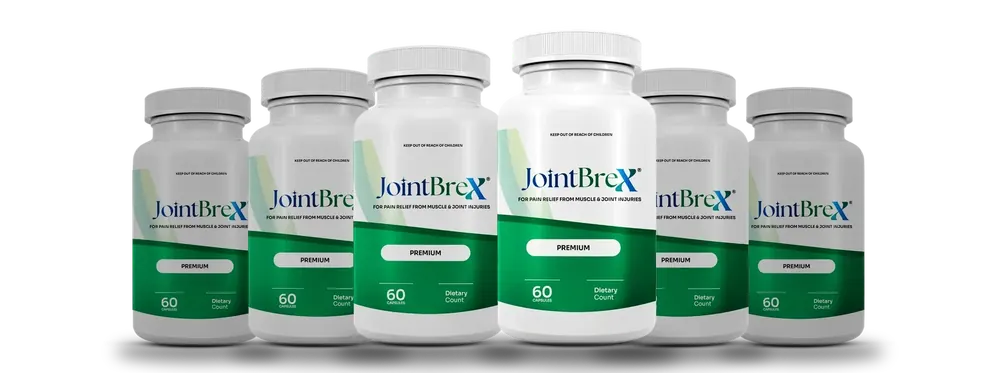
Weighing up JointBrex? The lowest cost per bottle comes with the 6-bottle pack.
$49 a bottle in the 6-pack ($294). Free US delivery on 3 or 6 · 60-day refund window · BuyGoods checkout.
Glucosamine sulfate vs hydrochloride: which one did the studies use?
Both forms were studied, and neither has a clear win. The large US trial used hydrochloride, while the positive trials in the Cochrane review came mostly from one prescription brand of the sulfate form.
- Hydrochloride (HCl)
- The form used in GAIT, which found no overall benefit over placebo (Arthritis Foundation, Glucosamine and Chondroitin for OA Pain).
- Sulfate
- Favored by some Mayo Clinic researchers, per the Arthritis Foundation, though one head-to-head study found no real difference.
- The Rotta product
- Trials of this one prescription glucosamine sulfate were positive; trials of other preparations, and the best-concealed trials, showed no pain benefit.
- JointBrex
- Glucosamine sulfate from crayfish. The label does not link it to the Rotta product, so those results cannot be borrowed.
Why is the JointBrex glucosamine made from crayfish?
Because shellfish shells are the usual raw material. LiverTox says glucosamine is mostly made from shellfish exoskeletons or by fermenting grain (LiverTox (NIDDK), Glucosamine), and the JointBrex label names crayfish.
People search for glucosamine without crustaceans for a reason. The grain-fermented kind exists, but this bottle is not it. Memorial Sloan Kettering warns that people with a shellfish allergy may react to glucosamine (Memorial Sloan Kettering, Glucosamine (About Herbs)), and the Arthritis Foundation tells them to avoid it.
Glucosamine before or after a meal?
The JointBrex label says before a meal, and the sales page adds a full glass of water. None of our sources compared timings, so before a meal is the brand's direction rather than a tested rule.
Gauge: capsules taken today (the label serving is 2, before a meal). Dial: the time of day you picked.
Breakfast, lunch or dinner: pick the one you never skip, so the dose lands at the same time each day.
Swallow both with water shortly before that meal. The label gives no number of minutes.
Upset stomach was the side effect GAIT reported most (NIH news release, GAIT results (2006)). If it bothers you, ask a pharmacist before changing the routine.
Start again tomorrow with two. The label says not to exceed the dose, so do not double up.
Storage, missed days and mixing with other supplements are on the how to take JointBrex page.
Can you take glucosamine with Eliquis or other blood thinners?
Only after your prescriber agrees. Our sources describe glucosamine raising the effect of warfarin; none we opened studied Eliquis (apixaban), and a missing study is not proof of safety.
What the reports show
Singapore's Health Sciences Authority pooled reports from Australia, the UK and the WHO database. INR, the warfarin blood test, rose in 10 of 12 Australian cases, and of 22 WHO cases, 21 showed a stronger warfarin effect (Health Sciences Authority, Warfarin-glucosamine interaction reports). Some patients bled and needed hospital care or vitamin K. Memorial Sloan Kettering adds that glucosamine may slow platelet clumping.
One more point for Eliquis users: the other ingredients matter too. Seven of the eight JointBrex ingredients carry a bleeding or blood thinner caution in our sources; only methionine does not. Bring the whole label to the person who prescribes your anticoagulant.
Does glucosamine affect blood sugar?
It may. NCCIH says glucosamine may raise blood glucose (NCCIH, Glucosamine and Chondroitin for Osteoarthritis), and Memorial Sloan Kettering says it could worsen insulin resistance. With diabetes, check with your doctor and test your sugar more often in the first weeks. The full safety list is on the JointBrex side effects page.
Does glucosamine work? GAIT, Cochrane and the 2019 guideline
The weight of evidence leans no. The biggest US trial saw no overall gain, the main review found benefit tied to one brand, and the 2019 US arthritis guideline came out against it.
In GAIT, 60.1% of the placebo group reached a 20% drop in knee pain; glucosamine added just 3.9 points, and only the drug celecoxib did significantly better (NEJM 2006, Clegg et al., GAIT trial). The Cochrane review of 4,963 patients found that well-run trials and non-Rotta products showed no benefit (Cochrane 2005, Towheed et al., Glucosamine for osteoarthritis).
NCCIH and a family medicine summary both report a strong recommendation against glucosamine (NCCIH Clinical Digest, Arthritis and Complementary Health Approaches) (Am Fam Physician 2020, Barry, summary of the ACR OA guideline); Memorial Sloan Kettering calls it conditional. What the guideline does strongly back is exercise, tai chi, weight loss if needed, self-management programs, and canes or braces. How glucosamine pairs with its usual partner is on the chondroitin page.
Glucosamine in JointBrex: questions people ask
Is 1,000 mg of glucosamine too much?
No. It is below the 1,500 mg a day most studies used. The label still says not to exceed 2 capsules a day.
How many mg of glucosamine should I take per day?
Studies mostly used 1,500 mg, but even that did not beat placebo overall in GAIT. Follow the label you have and ask your clinician about your own case.
Can you take glucosamine with Eliquis?
Ask your prescriber first. Our sources report glucosamine raising warfarin's effect; none studied Eliquis, and most other JointBrex ingredients carry bleeding cautions too.
Should you take glucosamine on an empty stomach?
The JointBrex label says before a meal. No source we used tested timing; stomach upset is the most common complaint.
Is there glucosamine without crustaceans?
Yes, some is made by fermenting grain. The glucosamine in JointBrex is not; the label names crayfish.
Which is better, glucosamine sulfate or HCl?
Neither has been shown clearly better. GAIT used HCl, and one head-to-head study found no real difference.
Does glucosamine raise blood sugar in people with diabetes?
It may, according to NCCIH, and it could worsen insulin resistance. Check with your doctor and monitor your readings.
Can I take 3 JointBrex capsules to reach 1,500 mg?
No. The label says do not exceed the 2-capsule dose, and a third capsule would raise every other ingredient too.
Page check
Written by
Matches each amount to the printed Supplement Facts panel and each safety line to federal health agencies and Cochrane reviews.
- Reviewed against the label on October 13, 2026
- Sources: the Supplement Facts panel, the brand pages we opened, and the studies linked on this page
- Spotted a mistake? Email [email protected]. Our method is on the editorial standards page