Boswellia in JointBrex: 133.3 mg of Resin Extract Checked Against the Trials
Quick answer
JointBrex lists 133.3 mg of Boswellia serrata resin extract per 2-capsule serving. That is the one amount on the label inside the 100 to 250 mg range used in trials. Those trials tested branded extracts boosted in AKBA, and this label gives no standardization. Ask first if you have asthma or take a blood thinner.
What does the JointBrex label say about boswellia?
The Supplement Facts panel lists "Boswellia Extract (Boswellia serrata) (resin)" at 133.3 mg per serving of 2 vegetable capsules. It is the second-largest line on the panel, behind 1000 mg of glucosamine sulfate.
That line names the species and the plant part. It leaves out the standardization, the boswellic acid content and the maker. Tap a number on the label for the details we checked.
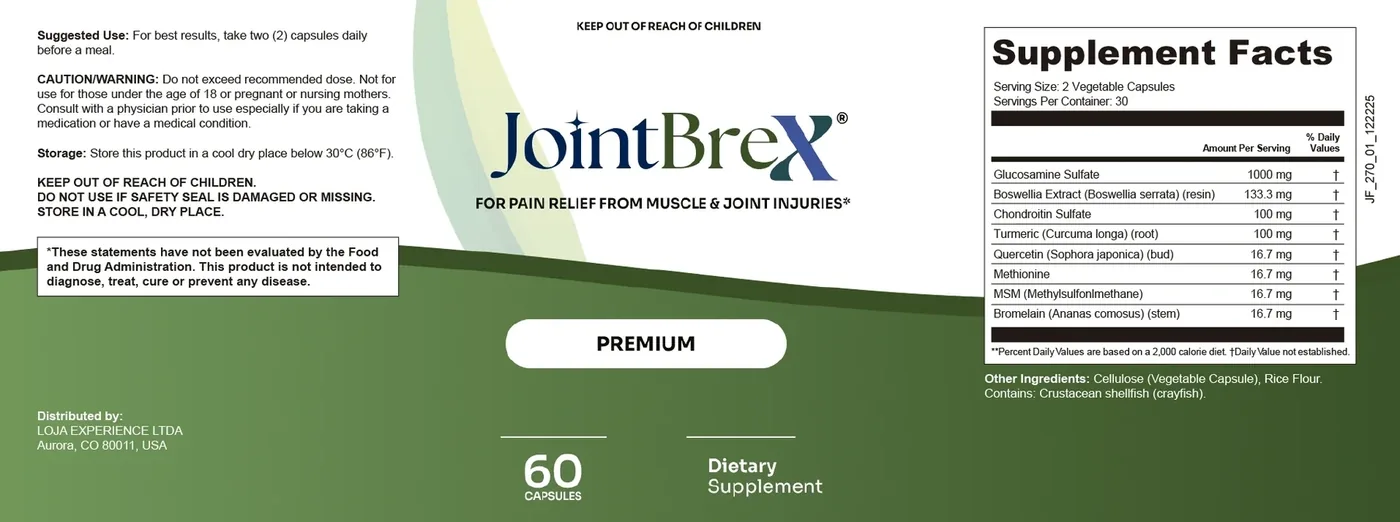
- The boswellia row. 133.3 mg of a resin extract from Boswellia serrata. That is about 9.5% of the 1,400.1 mg the panel lists in all.
- The dagger mark. It means no Daily Value has been set. The same mark sits beside all eight ingredients, so the panel itself cannot tell you whether 133.3 mg is a lot.
- Serving size. 2 vegetable capsules, 30 servings per bottle. A full bottle holds 3,999 mg of boswellia extract, just under 4 grams.
- The warning block. "Consult with a physician prior to use especially if you are taking a medication or have a medical condition." For boswellia, that line covers asthma and blood thinners.
- Label wording
- Boswellia Extract (Boswellia serrata) (resin)
- Per serving
- 133.3 mg in 2 capsules
- Per bottle
- 3,999 mg over 30 servings
- Standardized to
- Not published
- Extract brand or maker
- Not published
What is Boswellia serrata resin, and why does the extract type matter?
Boswellia serrata is a tree, and its resin is the starting point for the extracts tested on sore knees. The trials that held up best used extracts enriched in AKBA, one of the boswellic acids, with brand names like 5-Loxin and Aflapin (Arthritis Foundation, Supplement and Herb Guide for Arthritis Symptoms).
Here is the snag for JointBrex. Its label calls the ingredient a resin extract and stops there. Even the word "standardized" is absent, so there is no AKBA figure to hold up against the trial products.
| Detail | Trial extracts | JointBrex label |
|---|---|---|
| Species named | Boswellia serrata | Boswellia serrata |
| Brand of extract | Named: 5-Loxin, Aflapin | Not published |
| Enriched in AKBA | Yes, by design | Not stated |
| Daily amount | 100 mg in the best data; 250 mg in one arm | 133.3 mg |
| Tested for how long | 4 to 12 weeks; 90 days in Cochrane's best data | No study of this product |
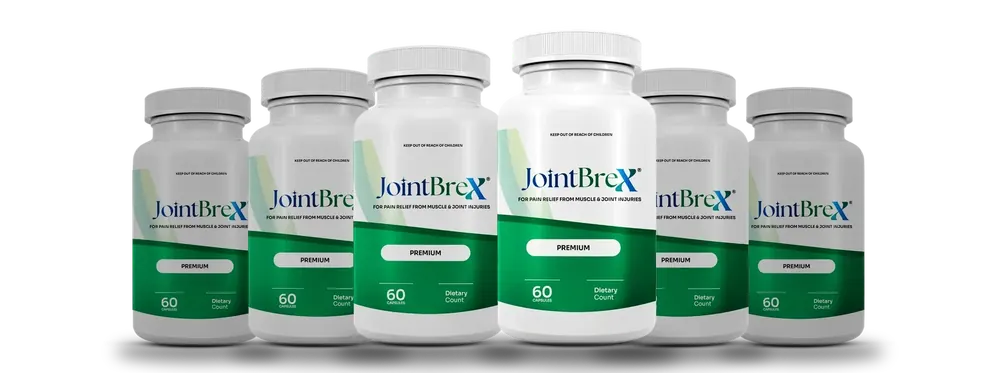
Weighing up JointBrex? The lowest cost per bottle comes with the 6-bottle pack.
$49 a bottle in the 6-pack ($294). Free US delivery on 3 or 6 · 60-day refund window · BuyGoods checkout.
Boswellia dosage for joints: how does 133.3 mg compare?
It falls inside the studied window. Trials of named extracts used 100 to 250 mg a day, and 133.3 mg sits a third above the bottom of that range.
| Source | Daily amount studied | JointBrex as a share | Note |
|---|---|---|---|
| Cochrane 2014 (Cochrane 2014, Cameron and Chrubasik, Oral herbal therapies for OA) | 100 mg enriched extract for 90 days | 133% | Moderate-quality evidence from 2 studies, 85 people |
| Yu 2020 (BMC Complement Med Ther 2020, Yu et al., Boswellia meta-analysis) | 100 or 250 mg of Aflapin or 5-Loxin | 133% or 53% | Dosing frequency is not given in the pooled table |
| NCCIH (NCCIH, Boswellia: Usefulness and Safety) | Up to 1,000 mg a day; 2,400 mg for up to 1 month | 13% of 1,000 mg | A safety range, not a target dose |
Weight is only half the comparison. A 133.3 mg extract of unknown strength could carry more AKBA than the trial products or far less, and the label gives no way to tell which.
Timing is the other half. Cochrane's best figures were taken at 90 days, while the refund window on every pack is 60 days from purchase. That window closes about a month before the point where those trials measured their result.
Does boswellia work for joint pain? What the reviews found
Possibly a little, in small trials of specific extracts. The pooled numbers look good on paper, but the studies behind them are few and uneven.
Cochrane pooled 2 studies with 85 people on 100 mg of enriched extract. After 90 days, pain scores fell by about 17 points and function scores rose by about 8, on scales from 0 to 100, with no serious adverse events.
A 2020 meta-analysis of 7 trials and 545 people also favored boswellia for pain, stiffness and function. Its results varied wildly from trial to trial, and the authors flagged statistics in three trials as not done correctly. Memorial Sloan Kettering sums up the field as useful in reports but conflicting (Memorial Sloan Kettering, Boswellia (About Herbs)).
Pros
- The label amount sits inside the 100 to 250 mg range used in trials.
- Cochrane rated its 100 mg evidence as moderate quality.
Cons
- The extract type and AKBA content are not on the label.
- NCCIH says most boswellia studies are small and of low quality.
- Trial results disagreed sharply, with heterogeneity of 93% to 99% for the main scores.
- No trial has tested JointBrex itself.
Is the sales page boswellia claim accurate?
Only in part. The sales page calls boswellia "A powerful resin used for centuries to fight inflammation", a line that mixes a history note with a health claim it never backs up.
- Marketing only
A powerful resin used for centuries to fight inflammation.
JointBrex sales page, ingredient listNo study is cited. NCCIH finds the high-quality evidence too thin to call boswellia useful for any condition (NCCIH, Boswellia: Usefulness and Safety).
- On the label
Boswellia Extract (Boswellia serrata) (resin) 133.3 mg
Bottle label, Supplement FactsPrinted with an exact amount. The sales page gives no milligrams for any of its ingredients.
- Marketing only
clinically tested nutrients that support joint regeneration
JointBrex sales pageBoswellia trials measured pain, stiffness and function scores, not joint regrowth, and none tested this capsule.
- Not shown
Standardized to a stated AKBA percentage
Usual on extracts like those in trialsNeither the label nor the sales page names one.
What are the side effects of boswellia, and who should ask first?
Trial side effects were uncommon and turned up no more often than in comparison groups. The real questions are asthma, blood thinners and what else sits in the same capsule.
- Trial safety. NCCIH judges oral boswellia likely safe at trial doses, which reached 1,000 mg daily for as long as 6 months; 2,400 mg daily for one month caused no obvious problems.
- Skin. Allergic skin reactions have been reported.
- Asthma. NCCIH asks anyone with asthma, or using asthma medicine, to talk with a provider before starting.
- Blood thinners and other drugs. Memorial Sloan Kettering warns that boswellia taken alongside warfarin or similar drugs may add to bleeding risk; the size of that effect is unknown. The Arthritis Foundation also notes it may make the side effects of some drugs stronger.
Four questions before boswellia
Do you have asthma, or use an inhaler or other asthma medicine?
Do you take warfarin, Eliquis or another blood thinner?
Are you pregnant, nursing or under 18?
Are you allergic to shellfish?
Answer every question to see your result. Nothing is saved or sent.
No flags here. Follow the label: two capsules daily, taken before a meal.
Bring the JointBrex label to your doctor or pharmacist and name the boswellia when you ask.
Do not use JointBrex. The label rules out pregnancy, nursing and anyone under 18, and it contains crayfish.
Is the boswellia a good reason to choose JointBrex?
It is the strongest line on the label, though not a sure thing. Of the eight ingredients, it is the only one whose amount sits in a studied range; the others fall below studied amounts, come in a different form, or have no studied dose at all.
If boswellia is why you are looking, the open question is strength, not weight. Compare every amount on the JointBrex ingredients page, or see the full panel on the supplement facts page.
The turmeric root tells a different story, and every caution across the formula is on the JointBrex side effects page.
Boswellia in JointBrex: your questions answered
What is Boswellia serrata resin?
It is the resin of the Boswellia serrata tree, the raw material for the boswellia extracts tested in joint trials. JointBrex lists 133.3 mg of an extract made from it in each 2-capsule serving.
How much boswellia is in a JointBrex serving?
133.3 mg of boswellia extract in 2 capsules, which is the full daily serving on the label. A 60-capsule bottle holds about 4,000 mg in total.
Is the boswellia in JointBrex standardized to AKBA?
The label does not say. The trial extracts were AKBA-enriched products such as 5-Loxin and Aflapin, so ask the order desk for the standardization in writing if it matters to you.
Which is better for joints, turmeric or boswellia?
No source we use compared them head to head. In JointBrex, boswellia is the one ingredient at a studied amount, while the 100 mg of turmeric is plain root rather than the curcumin extracts used in trials.
Is boswellia safe if I have asthma?
Ask first. NCCIH says people with asthma, or who take asthma medicine, should check with a health care provider before using boswellia.
Can I take boswellia with warfarin or Eliquis?
Talk to the clinician who manages your blood thinner before you start. Memorial Sloan Kettering warns boswellia may add to bleeding risk alongside warfarin and similar drugs; our sources do not test apixaban (Eliquis) by name.
How many weeks did the boswellia trials last?
Between 4 and 12 weeks in the 2020 meta-analysis, and Cochrane measured its best data at 90 days. NCCIH reports trials lasting up to 6 months.
Is the JointBrex boswellia the same as 5-Loxin or Aflapin?
Nothing on the label says so. Those are named extracts with a known boswellic acid content; JointBrex names only the species and the resin.
Page check
Written by
Matches each amount to the printed Supplement Facts panel and each safety line to federal health agencies and Cochrane reviews.
- Reviewed against the label on October 13, 2026
- Sources: the Supplement Facts panel, the brand pages we opened, and the studies linked on this page
- Spotted a mistake? Email [email protected]. Our method is on the editorial standards page